

What is Runner’s knee?
If you suffer with pain around or behind your knee cap during running, jumping, squatting/lunging, stair climbing or sitting for long periods of time, you probably have patellofemoral pain – A.K.A Runner’s knee.
Although this is the most common injury experienced by runners, the term Runner’s knee is somewhat misleading because it is experienced by people participating in various sports and other physical activities.
What causes Runner’s knee?
Runner’s knee is caused by excessive running, jumping or squatting/lunging based activities; the classic overuse injury mechanism. When the knee can no longer handle the stress placed on it over time by these activities, it can cause sensitivity and pain around or behind the knee cap.
Other factors that commonly contribute to increased stress on the knee include:
- Decreased knee and hip strength
- Inefficient movement and/or alignment of the hips, knees or feet during activity
- Training surface, shoes or other equipment
How do we treat Runner’s knee?
1. Load Management
It is vital to manage the load on the knee by reducing or stopping activities that increase pain, for a period of time. These days, the idea is to keep you as active as possible without it slowing down your recovery.
Rule of thumb:
- Reduce activity, so that pain does not increase to more than a mild level during the activity and,
- returns to normal levels of pain (for you), by the next day
To achieve this, you might need to reduce training:
- Distance/time
- Intensity
- Frequency (days per week)
Stopping activity all together will decondition your knee and even though your pain might decrease now, when you start activity again, the pain often comes right back. In some very sensitive cases you might need to rest completely to allow the knee to calm down.
You can then gradually increase your training as long as you stick to the rule of thumb.
ProTip: Increase frequency before increasing distance/time. Once your desired frequency and distance/time is achieved, then only should you increase intensity.
2. Exercise Rehab
According to a group of leading researchers in the field of patellofemoral pain – “Exercise therapy is the intervention of choice for patellofemoral pain, with the largest body of evidence supporting its use to improve pain and function in the short, medium and long terms.”[1]
Strength training that targets the muscles of the knee and hip can increase the ability of the knee to tolerate load. A combination of exercises that isolate individual muscles and exercises that resemble the tasks you struggle with, should be used. The challenge is finding a group of exercises that don’t aggravate your knee (e.g., figures 1-4). Modifying the range of motion, intensity and total volume (sets and reps) can allow for improvement without increasing pain. This is where an experienced Biokineticist can really be helpful to develop a custom treatment plan to help rehabilitate your injury.
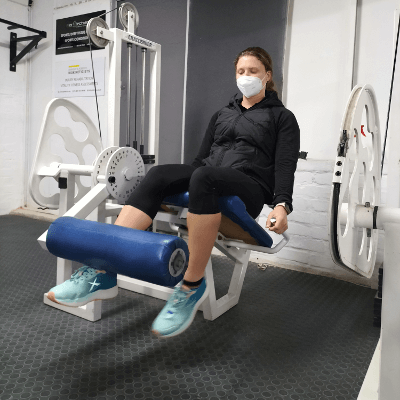
Figure 1 – Single leg extension
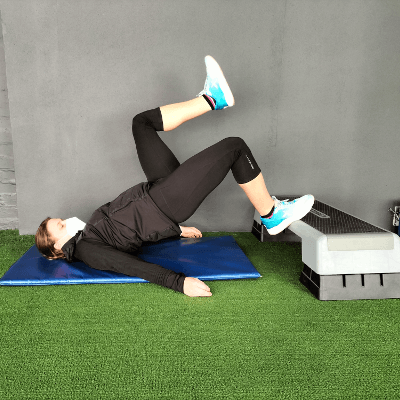
Figure 3 – Single leg glute bridge
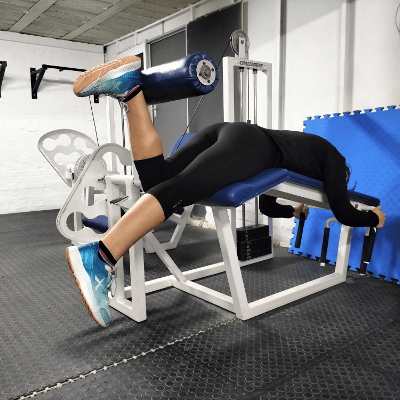
Figure 2 – Single leg curl
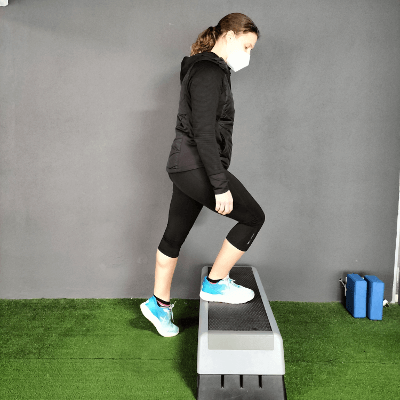
Figure 4 – Step up
Identifying the muscles that are weak can be useful in deciding which exercises to choose. We
use a handheld dynamometer (figure 5) to test hamstring, quadricep and gluteal muscle strength
(figures 6-8).
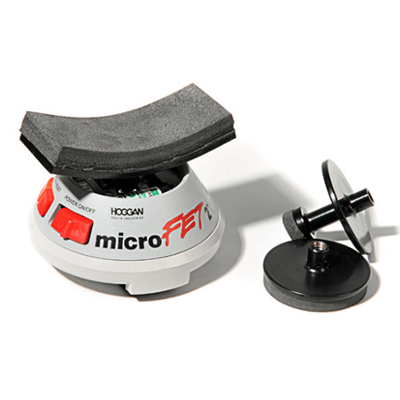
Figure 5 – Handheld dynamometer
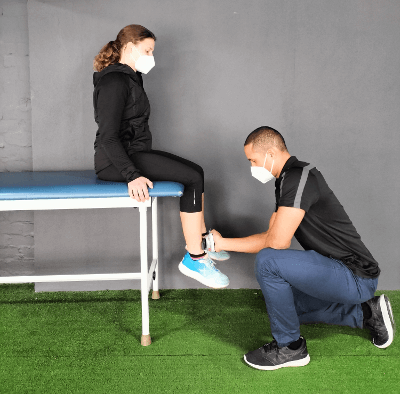
Figure 7- Quadriceps muscle force test
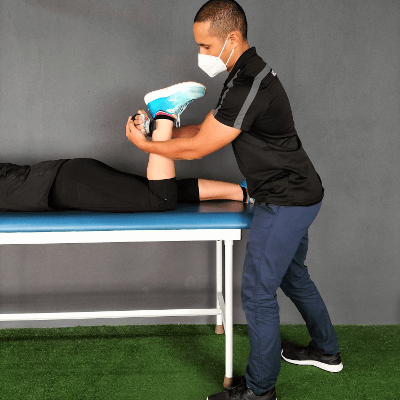
Figure 6 – Hamstring muscle force test
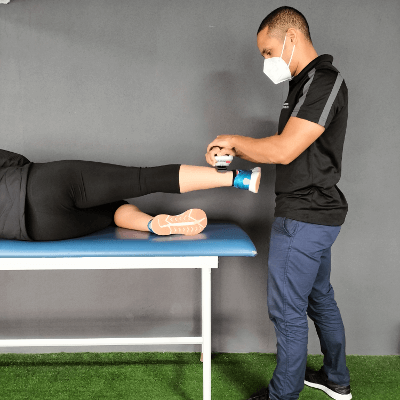
Figure 8 – Gluteus medius muscle force test
3. Running gait modification
If your activity involves running, then changing the way you run can potentially decrease load on your knee.
Some useful modifications include:
- Increased step rate (and decreased stride length)
- Forefoot strike (landing towards the front of the foot)
Running gait modifications should always be gradual. Changes that are drastic can cause problems of their own.
4. Other treatments to consider
Although Load management and exercise rehab are seen as the most effective stand-alone treatments, they are not always as successful as we would like them to be. So, for those stubborn cases it might be beneficial to consider additional treatments:
- Knee taping and bracing
- Foot orthoses
- Bloodflow restriction training
These treatments are beyond the scope of this post and should be discussed with your Biokineticist.
How long does it take for treatment to work?
As with any overuse injury, timelines for recovery vary greatly from one person to the next. You should budget for at least 3 months of performing an exercise rehab programme 2-3x per week, before expecting to see significant improvements in your pain and function. After 3 months you will likely need to continue with the programme to optimize results even further or to maintain the results you’ve achieved.
If it’s not Runner’s knee, what else can it be?
A number of injuries can cause pain in similar areas to Runner’s knee. These injuries might require different treatment plans, so it is important to determine the correct diagnosis.
Other diagnoses to consider:
- Patella tendinopathy
- Fat pad injury
- Intra-articular pathology (ligament, meniscus, cartilage)
- Bursitis
A knowledgeable Biokineticist can assist in differentiating between these conditions or refer you to the relevant healthcare profession for further investigation.
Key Takeaways
In conclusion, treating your Runner’s knee can be as simple as decreasing your training and gradually building back up as pain allows. But, we also know that it can be a stubborn injury that requires some finesse when it comes to choosing and implementing the treatments that will most likely be successful. For those stubborn cases, consulting an experienced Biokineticist is strongly recommended.
Contact Us
If you are suffering from Runner’s knee and would like a more personal injury assessment, get in touch with us or book a consultation!
Disclaimer: This content is not medical advice and is intended for general education purposes only. It should not be used to self-diagnose or self-treat any medical condition. Do not use this information to avoid going to your own healthcare professional or to replace the advice they give you. Dhansay and Roberts Biokineticists makes no representations about the accuracy or suitability of this content.
References:
- Collins, N. J., Barton, C. J., van Middelkoop, M., Callaghan, M. J., Rathleff, M. S., Vicenzino, B. T., Davis, I. S., Powers, C. M., Macri, E. M., Hart, H. F., de Oliveira Silva, D., & Crossley, K. M. (2018). 2018 Consensus statement on exercise therapy and physical interventions (orthoses, taping and manual therapy) to treat patellofemoral pain: recommendations from the 5th International Patellofemoral Pain Research Retreat, Gold Coast, Australia, 2017. British journal of sports medicine, 52(18), 1170–1178. https://doi.org/10.1136/bjsports-2018-099397