
Injury Rehabilitation: Assessment & Treatment
What is the goal of injury rehabilitation?
The reason why sustaining an injury can be so profoundly distressing is not necessarily because of pain but because it limits you in doing the activities that give meaning to your life. It might affect your ability to play sports, be productive at work or spend quality time with family. The goal of injury rehabilitation is, therefore, not only to reduce your pain but to assist you in getting back to your purpose.
How can Dhansay and Roberts Biokineticists assist you with injury rehabilitation?
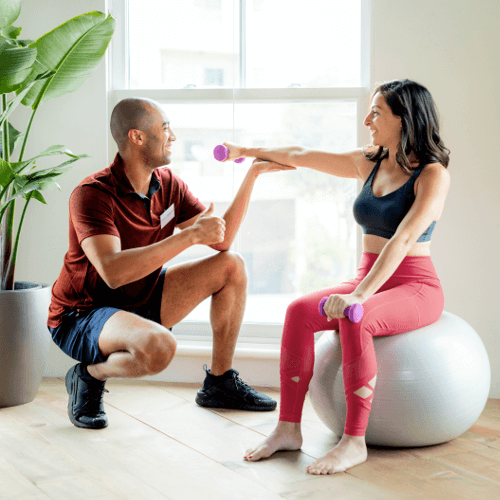
As Biokineticists, we rehabilitate injuries using individualised assessment and tailored exercise programmes to decrease pain and improve function – getting you from where you are now, to where you want/need to be physical.
At Dhansay and Roberts Biokineticists, we use sophisticated assessment methods to identify the factors that contribute to your pain and functional limitations.
Our assessment consists of:
- A thorough history taking to understand the injury from your perspective.
- Tests to determine (or confirm) likely pathologies.
- A physical examination includes tests for strength, flexibility, stability, movement patterns and control. After an initial assessment, we have enough data to proceed with a customized exercise-based rehabilitation plan to start your road to recovery.
Rehabilitation is supervised at one of our practices in Cape Town – We are located in Claremont and Green Point for your convenience.
Types of injuries we rehabilitate
Even though we often work with professional and recreational sportspeople, our services can benefit people from all walks of life – Individuals who sustain injuries at home, in the workplace or at school. If your injury needs an exercise-based rehabilitation programme, we can help you.
We treat 3 main types of injuries:
- Overuse
- Post-surgery
- Traumatic
Biokineticists will intervene at different stages of the rehab process depending on the type of injury.
1. Overuse injuries
These are injuries we can help rehabilitate from the start of the rehab process. Overuse injuries are caused by excessive activity over a period of time (instead of a sudden injury event). Some common examples are:
- Achilles tendinopathy
- Patellofemoral pain syndrome (runner’s knee)
- Rotator cuff tendinopathy (shoulder impingement)
- Patella tendinopathy (jumper’s knee)
- Illiotibial band (ITB) syndrome
- Medial tibial stress syndrome (shin splints)
- Lateral elbow tendinopathy (tennis elbow)
- Plantar fasciitis
- Hamstring tendinopathy
- Groin pain – adductor, hip flexor, pubic or inguinal-related
- Gluteal tendinopathy
2. Injuries post-surgery
Biokineticists treat injuries post-surgery after physiotherapy is completed. Post-surgery injuries we can help rehabilitate (including but not limited to):
- ACL reconstruction (knee)
- Meniscus repair/meniscectomy (knee)
- Rotator cuff repair (shoulder)
- Lumbar spine surgery (lower back)
2. Traumatic injuries
Traumatic injuries are caused by a sudden injury event. Biokineticists treat these injuries after physiotherapy is completed. Examples of Traumatic injuries we can help rehabilitate (including but not limited to):
- Muscle strain
- Ligament sprain
- Bone fracture
- Other soft tissue injury
We provide evidence-based injury rehabilitation
At Dhansay and Roberts Biokineticists we pride ourselves on using evidence-based injury assessment and rehabilitation methods, to provide our patients with effective rehabilitation outcomes.

Benefits of injury rehabilitation
Dealing with your injuries can be a frustrating and unnecessarily painful process. Seeking help from an experienced Biokinetics practice can be beneficial in making that process a lot more bearable. At Dhansay and Roberts Biokineticists we aim to:
- Guide you through an evidence-based exercise rehabilitation plan that addresses your individual injury needs.
- Reduce your risk of reinjury
- Help you understand your injury and make sense of your pain:
- What is the problem? Why did it occur? and why isn’t it getting better?
- What should you expect from the treatment and which treatment options are effective?
- When and how do you safely return to specific activities?
- How long is the recovery process expected to be?
- How do you manage a flare-up in your pain?
When Is The Best Time To Start An Intervention?
The earlier the better. Receiving quality, evidence-based information early on in the process can be an important step towards achieving the best possible outcome.
Whether you “just have a niggle” and need some advice on how to continue training without making the problem worse, or you have a more debilitating injury that needs a structured rehabilitation plan, we can help you figure out the steps to recovery. Learn more about our rehabilitation process here and start your recovery journey with us.
Start Your Recovery Journey
Book your consultation with Dhansay & Roberts Biokineticists today, and let us help you manage your injury rehabilitation. Have questions before you book? Contact us here or chat to us on WhatsApp, we're happy to help.
Book Your Initial Assessments