

Lower back pain is the leading cause of disability globally and affects both athletes and the general population. Up to 85% of the population will experience lower back pain at some point in their lives. However, only 1 to 2% of people with lower back pain will have a serious or systemic disorder. This means that lower back pain is a normal human experience that should not be feared and if it does occur (which is very likely), it helps to have a good understanding of how to manage it. So let’s start with the basics…
Understanding The Anatomy Of The Lower Back
Your lower back is the region between the upper part of your buttocks and the lowest pair of ribs. This region consists of the lumbar vertebrae (the bones that form the main structure of the lower back), lumbar discs numbered L1 – L5 (which sit between vertebrae and help with shock absorption) and the connecting muscles and ligaments. These can all be responsible for causing lower back pain if injured. The spinal cord runs through the centre of the interlocking vertebrae that protect it. Branching off from the spinal cord are the nerves that travel all over the body to send electrical signals for various bodily functions. If nerves are injured in the lower back, they can cause radiating pain, weakness and numbness in the legs and feet.
What Causes Lower Back Pain
There are a variety of factors that could cause lower back pain. In many cases, two or more factors must interact together to cause lower back pain. Let’s take a look at the factors most commonly associated with lower back pain:
1. Trauma
Can be caused by an incident involving an awkward fall, a collision with an opponent when playing sport, a car accident or heavy lifting e.g. moving furniture, gym deadlifts or squats.
2. Overuse
Can be caused by activities that involve repetitive and excessive lifting, carrying, bending or twisting (not a single incident). Examples include manual work occupations, gardening or sport participation.
3. Sustained postures
Although there is NO strong evidence for an inherently “bad” posture, for some individuals, a particular posture can be aggravating if maintained for a period of time. For example, a long distance runner, in an attempt to run with a more upright posture, overcompensates and runs with an extended (arched) lower back posture, putting excessive strain on her lower back over time.
4. Physical factors
Some activities have a greater requirement for lower back mobility, strength, endurance or stability (intrinsic physical factors). Lacking those physical attributes along with increased training load and improper equipment (extrinsic physical factors), can put you at greater risk of developing lower back pain. For example: a golfer has limited lower back muscle endurance (intrinsic factor) and golf clubs that are too short for her (extrinsic factor). Because of this, she has to bend over forward excessively to address the golf ball, which means her lower back muscles have to work harder than they should. She is also hitting twice as many golf balls as usual at the driving range in preparation for a club competition (extrinsic factor). She is at risk of developing lower back pain because of the strain on her back from the combination of these physical factors.
It is important to recognise that pain is caused by more than just the physical loads you place on your body. Other factors that might contribute to your pain include:
5. Psychological factors
Fear of pain and movement along with stress, anxiety, depression, anger and frustration can exacerbate your pain. But how do psychological factors have an effect on back pain? The simplified answer is that:
- psychological factors can have an effect on our behaviours, which can increase our pain. For example, someone might avoid flexing their back (bending forward) because of the fear of causing pain, even though in that person’s case, bending forward through a minimal amount of pain is necessary to improve their function and decrease their pain over time.
- psychological factors can have an effect on our physiology. Have you ever been so stressed and that you felt your heart rate increase, your muscles become tense and maybe even felt physically sick? This is an example of how a psychological factor can affect our bodily systems. In a similar way, psychological factors can also affect our bodily systems to cause or exacerbate pain.
6. Lifestyle factors
A lack of physical activity, abdominal obesity, poor sleep, excessive alcohol and smoking are all known risk factors for developing lower back pain.
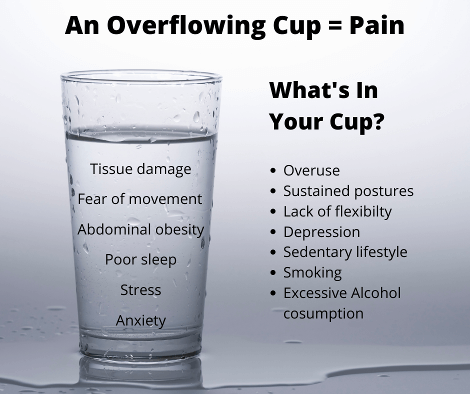
The Cup Analogy
To understand how these factors work together to cause pain, the cup analogy is useful. The cup represents YOU as a person. The cup gets filled with all of the factors (see above) that are known to contribute to pain. Let’s call them stressors. When the stressors in our lives exceed the space we have in our cup, the cup overflows and we have pain.
Start thinking about what might be in your cup and what you can do to empty it.
Common Symptoms & Signs Associated With Lower back Injuries
Lower back injury is often very distressing because of how severe the symptoms can be and the fear of the consequences associated with these symptoms. Understanding which symptoms are actually cause for concern and might require emergency medical care, will help you to take appropriate action.
Here is a list of signs and symptoms that should motivate you to seek urgent medical care:
- Severe or progressive loss of muscle strength or sensation in your legs or feet
- Bladder, bowel or sexual dysfunction
- Unexplained weight loss
- Severe pain from major trauma (motor vehicle accident, heavy fall etc.)
Note that even severe pain and back spasms on their own are not necessarily reasons to seek emergency medical care. These symptoms can be extremely distressing, but if not associated with the symptoms above, most often recover well.
Other symptoms you might experience with a lower back injury include:
- Pain that might be localised (in a specific location) or more spread out in the lower back region. Pain might also originate from the back but be felt more in the legs or feet
- Pain that can be dull aching, sharp, shooting or burning in nature
- Spinal stiffness or decreased range of motion
- Muscle spasm
- Pins & needles, burning, itching or numbness on the skin
How To Treat Back Pain
In the case of acute lower back pain, treatments for pain relief are often helpful in the short term to reduce distress and severe pain. Treatments might include massage, mobilisations, manipulations, dry needling, spinal injections and medications. Your Physiotherapist/Chiropractor and Doctor should be consulted to provide these treatments. If you aren’t in a position to access these services there are DIY solutions to help relieve your own pain:
1. Find your positions of comfort
- Options include (but are not limited to):
Lying on your back with your feet up on a chair or pillow under your knees. - Half lying and half seated in bed with pillows behind your back to maintain the position.
- Lying on your side with a pillow between your knees.
- Seated relaxed on a chair with a towel roll behind your lower back to maintain a slightly arched position.
- Seated relaxed in a chair with your lower back slightly rounded.
- Child’s pose position.
2. Deep breathing and relaxation
People with back pain tend to tense their muscles to protect their backs. This can actually increase the load on the spine and increase potentially pain. Practising deep breathing and relaxation of core muscles especially when in a position of comfort can help reduce pain.
3. Ice or heat
- People have different responses to ice and heat, so try both and choose which works best for you.
- Apply ice for 10-15mins every hour. A bag of frozen peas or an icepack should do the trick.
- If your lower back is in spasm, heat is often your best bet. Take a hot shower or bath. Be aware that it might be challenging to get in and out of the bath so this might not always be the best option.
4. Pain medication
If you don’t have prescription medication from your doctor, there are over-the-counter options. Anti-inflammatory medications should be used cautiously and only as indicated. Ask your trusted pharmacist for advice. Other pain relievers to consider are anti-inflammatory patches and creams.
Once pain is at a manageable level, gentle movement that is tolerable is recommended to be done multiple times a day to restore normal range of motion and avoid developing lower back stiffness. Tolerable means that the pain does not significantly increase while doing the movements and is not worse the following day. This might include movements that flex, extend, side bend or rotate the spine (see Exercises To Rehabilitate And Relieve Pain In The Lower Back).
7 Most Common Lower Back Injuries
1. Sciatica:
Sciatica is a condition that is characterised by lower back and radiating pain down one leg or foot, with or without weakness, numbness and pins & needles. This occurs most often because of an intervertebral disc herniation in the lower back that causes compression of a nerve as it exits the spinal column. This can be an extremely painful and distressing condition.
Commonly Caused By:
A disc herniation from a forward bending incident such as a gym deadlift or picking something up off the floor in an abnormal posture OR after a period of rapid increase in repetitive flexion loading of the spine, for example after a few days of bending and lifting from moving to a new house, which makes someone more susceptible to a forward bending incident happening.
Treatment:
A surgical opinion should be considered if weakness and numbness progressively gets worse or if pain is unmanageable. Common surgical procedures include lumbar discectomy (removal of a part of the disc) and lumbar laminectomy (removal of a part of the vertebra) to decrease compression on the nerve.
Non-surgical treatment might include pain medication or corticosteroid injection, in the case of severe pain. Gentle lower back and hip mobility exercises that do not cause a flare-up in pain should be performed. Sitting should be minimised and gentle walking commenced as soon as tolerated. Gentle nerve mobilisation exercises can be attempted (note that nerves can be very sensitive and easily flared up). Reintroduction to normal daily activities, exercise and sport should be done gradually, while improving mobility, strength, endurance and stability as required for the activities you want to participate in.
2. Lumbar Spondylolysis (Stress Fracture In The Lumbar Spine)
A stress fracture is a tiny crack in a bone that occurs because of repeated stress rather than a single injury incident. Lumbar Spondylolysis is a stress fracture that occurs in a particular region of one or more lower back vertebrae.
Commonly Caused By:
Overuse from sports involving excessive and repetitive spinal rotation, extension and side-bending. These include sports such as cricket, tennis, gymnastics, soccer, volleyball, athletics and dancing
Treatment:
For the first 8 weeks during the fracture healing phase, it is important to protect the fracture by stopping sports and other activities that involve running, jumping and landing. Also, avoid training activities such as repetitive or end-range lower back extension, rotation or side-bending and resistance-based strength training that involves axial loading (force directed from the top of the spine downwards) such as weighted squats, lunges, shoulder press etc.
From week 9, if symptoms have settled, axial loading should start with body weight and progress to resistance-based exercises. Lower back extension, rotation or side-bending exercises should be commenced and progressed. Gradual reintroduction of jogging is allowed. If this is well tolerated by week 12, adopt a cautious return to sport-specific activities.
3. Lumbar Spondylolisthesis
Lumbar Spondylolisthesis is a condition where a vertebra of the lower back has slipped forward on the vertebra below it, out of its proper alignment. Symptoms include lower back pain with or without leg pain, weakness, numbness and pins & needles, which are made worse with lower back extension. Spondylolisthesis is most often preceded by Spondylolysis (stress fracture in the lumbar spine).
Commonly Caused By:
A birth defect or repetitive trauma to the spine with sports involving excessive and repetitive spinal rotation, extension and side-bending. These include sports such as cricket, tennis, gymnastics, soccer, volleyball, athletics and dancing.
Treatment:
Similar to Spondylolysis, initially avoid sports and other activities that involve running, jumping and landing. Avoid repetitive or end-range lower back extension, rotation or side-bending. Avoid resistance-based strength training that involves axial loading (force directed from the top of the spine downwards) until symptoms have settled. These activities should be cautiously reintroduced and gradually progressed as tolerated.
Surgery should be considered if 6 months of non-surgical treatment has been unsuccessful, or if neurological symptoms of weakness and numbness are progressively worsening, or if the pain is unmanageable.
4. Lumbar Spinal Stenosis
Lumbar spine stenosis is the narrowing of the spaces in the spinal vertebrae of the lower back through which the spinal cord and nerves pass through. This usually occurs as a result of degeneration of the spine due to the normal age-related changes or various forms of arthritis. Symptoms include pain that most often radiates down both legs or feet, with or without weakness, numbness and pins & needles. These symptoms are brought about when the spine is extended (arched) which results in further narrowing of the nerve pathways and is relieved with spine flexion (rounding).
Commonly Caused By:
Age-related degeneration or arthritis
Treatment:
Decrease excessive lower back extension activities and postures such as walking downhill, performing lower back extension exercises and sitting or lying with your lower back in extension. Perform mobility, strength, endurance and stability exercises in neutral or flexed lower back positions.
5. Sacroiliac Joint (SIJ) Pain
The joint that connects the base of the spine (sacrum) to the pelvis is known as the sacroiliac joint, which can be a source of lower back and buttock pain.
Commonly Caused By:
Trauma from a car accident, fall or collision results in a strain of the ligaments of the SIJ. Pregnant women have a greater chance of developing SIJ pain because of female hormones during pregnancy that relax the SIJ ligaments.
Treatment:
If pain is severe, short-term relief can be achieved with massage, mobilisations, manipulations, needling, injections and/or medications. Once pain is at a manageable level, the focus should be placed on increasing the capacity of the SIJ and surrounding tissues to withstand the load. Progressive strengthening of the hamstrings, gluteals and erector spinae (muscles that run alongside the spine) which interact functionally with the SIJ, should be performed. This might include exercises such as bridges, squats and deadlifts which can be progressed to single-leg versions to increase the load on the SIJ. Sports specific exercise (or other high load activity) should gradually be incorporated as tolerated.
6. Acute Lower Back Strain
Lower back injury with a clear history of trauma or overuse AND where we can rule out fracture, disc herniation and radiculopathy (nerve related symptoms), should be categorised as an acute lower back strain. Injured structures might include the muscle, disc, bone, joints or ligaments and should all be treated in a similar manner.
Commonly Caused By:
Trauma involving heavy lifting e.g. moving furniture or gym deadlifts and squats; a car accident, an awkward fall or a collision with an opponent playing sport etc.
OR overuse from manual work occupations, gardening, housework or sport participation.
Treatment:
Treatments for pain relief are often helpful in the short term to reduce distressing or severe pain. Treatments might include massage, mobilisations, manipulations, needling, spinal injections or medications.
Once pain gets to a manageable level, gentle lower back and hip flexibility exercise is recommended to be done multiple times a day to restore normal range of motion and avoid developing lower back stiffness. Light to moderate intensity cardiovascular exercise for 20-30mins each day is also recommended. Choose walking, cycling or swimming based on preference and comfort.
If you need to return to sport or a physical job that places high demands on your lower back, then gradually improve your mobility, strength, endurance or stability to the levels that the activity requires.
7. Cauda Equina Syndrome
Cauda equina syndrome is a rare but serious condition involving the compression of the bundle of nerves at the lower end of the spinal cord known as the Cauda Equina. These nerves send and receive messages to and from the legs, feet and pelvic organs. Symptoms might include severe lower back and radiating pain into the legs and feet, along with weakness, numbness and pins & needles. Bladder, bowel and sexual dysfunction are characteristic of this injury. Loss of sensation in buttocks, inner thighs and perineum is often associated.
Commonly Caused By:
A herniated disc or other severe lower back injury from a car accident, major fall or other severe trauma.
Treatment:
Cauda Equina is a MEDICAL EMERGENCY that requires surgery to relieve the compression on the involved nerves to prevent permanent bladder, bowel and sexual dysfunction.
Exercises To Rehabilitate And Relieve Pain In The Lower Back
Exercise can be an effective way of facilitating recovery from lower back pain and getting you back to full physical function. Before we discuss which exercises can be beneficial for treating lower back pain, let’s touch on which exercises should be avoided. There are no universally “bad” exercises for back pain, only exercises that are bad for YOUR back pain RIGHT NOW!
An exercise to avoid is one that:
- causes significant lower back pain and related symptoms
- causes worse pain the more of it you do
- causes pain that does not settled back down to your normal pain levels by the next day
These exercises should be avoided right now, but it does not mean they should be avoided forever. If your pain has improved after a period of avoiding these exercises, they can be cautiously attempted again. At this point they may no longer be “bad” exercises for you to do and could actually help you make a full recovery.
Now let’s take a look some exercise options for the treatment of lower back pain.
Exercise To Help Treat Lower Back Pain
1. Mobility
- Bending forward
- Side bending
- Prone cobra
- Child’s pose
- Pigeon stretch
- Lumbar rotation stretch
- (Download printable version)
2. Stability and core strength
- Planks (front, side, reverse)
- Crunches
- Back extensions
- (Download printable version)
3. General muscular strength and endurance
- Squats
- Lunges
- Push-ups
- Bicep curls
- (Download printable version)
5. Cardio
- Walking
- Cycling
- Swimming
The Approach
We see these exercises as options, NOT essentials. It might not be necessary to include all of these forms of exercise in order to make a full recovery. Also, no specific exercise type or combination has been scientifically proven to be significantly more effective than any other. So this allows you as an individual to choose exercises that you enjoy, that fit into your schedule and that don’t make things worse (see above exercises to avoid). This approach, over time, is often effective in helping you recover from lower back pain.
How Can My Biokineticist Help?
Where a Biokineticist can assist is in working with you, to figure out:
- Which exercises can help you
- Which exercises you struggle with but can be modified to help you
- Which exercises to avoid
- Which avoided exercises to reintroduce and how
If you need some help troubleshooting your back pain get in touch with our team. We can help you start your journey to healing.